
The Bible and Islamic Objections [Sermon]

Outline
1.0 What Does the Quran Say About Jesus
2.0 What Does Jesus Say About Himself
3.0 The Muslim Objections
1.0 Comparison of the Bible and the Quran
1.1 Nature of Revelation and Inspiration
Sermon on the Inspiration of the Bible
1.2 Authorship, Composition, and Structure
Feature | The Bible | The Quran |
|---|---|---|
Authors | ~40+ human authors | One prophet (Muhammad) |
Timespan | ~1,500 years of composition | ~23 years (AD 610–632) |
Languages | Hebrew, Aramaic, Greek | Classical Arabic |
Structure | 66 books: narrative, law, poetry, prophecy, epistle, apocalyptic | 114 surahs, arranged roughly by length (longest to shortest) |
Organization | Broadly chronological and thematic | Not chronological; organized by length |
Compilation | Books recognized over time by communities | Oral tradition compiled under Caliph Uthman c. AD 650 |
1.3 Content and Central Theme
The Bible's central content is God's redemptive acts in history — culminating in the person and work of Jesus Christ.
The Quran, by contrast, primarily reveals God's will and guidance for human submission.
1.4 Manuscript Tradition and Preservation
Feature | The Bible | The Quran |
|---|---|---|
OT Manuscript Evidence | Dead Sea Scrolls (250 BC–AD 68), 95%+ agreement with Masoretic Text | No comparable pre-compilation manuscript tradition |
NT Manuscript Count | ~5,800 Greek manuscripts | Single textual tradition from Uthmanic codex |
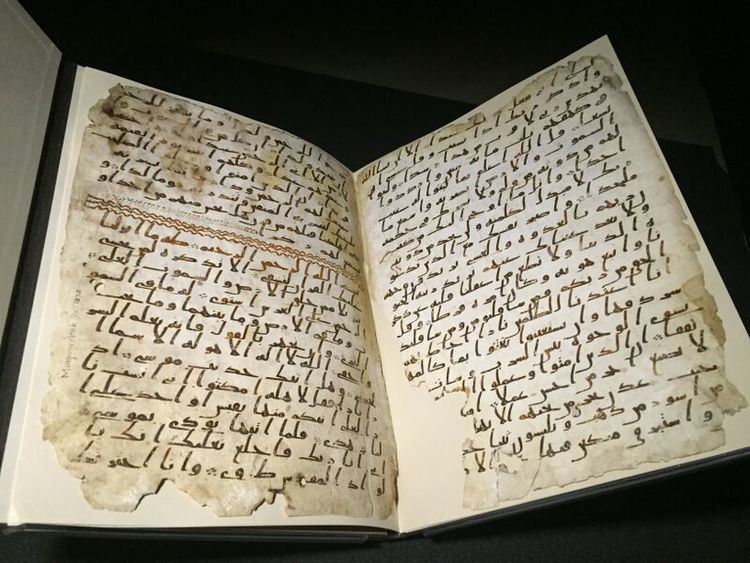
Earliest NT Fragment | John Rylands P52 (~AD 125–150) | Birmingham Quran carbon dated 568–645 AD |
Variant Readings | Thousands of minor variants; text substantially stable | 7 (or 10) official qira'at (recitation modes); Sanaa palimpsest shows pre-Uthmanic variants |
Transmission Method | Organic, multi-community, multi-language transmission | Centralized, state-enforced standardization; variant copies burned |
Approach to Variants | Transparent; textual criticism openly practiced | Non-standard readings were suppressed or destroyed |
1.5 Purpose and Function in Context
2.0 Islamic Objections to the Bible
2.1 Objection 1: The Bible Has Been Corrupted (Tahrif)
Surah 2:75 Do you then hope that they would believe in you, and a party from among them indeed used to hear the Word of Allah, then altered it after they had understood it, and they know (this).
Surah 3:78: Most surely there is a party amongst those who distort the Book with their tongue that you may consider it to be (a part) of the Book…
Responses:
1. The Quran Itself Affirms the Bible's Reliability.
Surah reference | Scripture mentioned | Key phrase about earlier Scripture | Implied status of earlier Scripture at Muhammad’s time |
|---|---|---|---|
3:3–4 | Torah and Gospel | “guidance for people” | Recognized as divine guidance for humanity |
5:44 | Torah | “guidance and light” | Torah is a present, reliable source of guidance |
5:46 | Gospel | “guidance and light” | Gospel is a present, reliable source of guidance |
5:47 | Gospel | “judge by what God has sent down in it” | Christians are to apply the Gospel they currently have |
10:94 | Earlier Scriptures (Bible) | “If you are in doubt about what We have sent down to you, ask those who have been reading the Scripture before you” | Muhammad was directed to consult existing earlier Scripture |
If those scriptures had already been corrupted, such a command makes no sense.
2. The Corruption Doctrine Was a Later Development.
3. The Quran Claims God's Words Are Inalterable, But Then Says the Bible Was Altered.
6:115: The Word of your Lord has been perfected in truth and justice. None can change His Words. And He is the All-Hearing, All- Knowing.
18:27 And recite, [O Muḥammad], what has been revealed to you of the Book of your Lord. There is no changer of His words, and never will you find in other than Him a refuge.
If this is true, then the Torah and Gospel cannot have been corrupted by human hands. The claim of tahrif directly contradicts the Quran's own theology of divine preservation.
4. Manuscript Evidence Contradicts the Corruption Claim.
5. Who Could Have Orchestrated a Global Corruption?
2.2 Objection 2: The New Testament Was Not Written in Jesus' Language
Responses:
1. Language of Composition Does Not Negate Inspiration.
2. The Same Objection Applies to the Quran.
3. Greek Was the Lingua Franca of the 1st Century.
2.3 Objection 3: The Bible Contains Contradictions
Surah 4:82 Do they not then reflect on the Quran? Had it been from anyone other than Allah, they would have certainly found in it many inconsistencies.
Responses:
1. Rival Interpretations Are Not the Same as Contradictions.
2. The Non-Contradiction Criterion Can Be Turned Against the Quran.
3. The Challenges Are Consistently Refuted.
2.4 Objection 4: The Bible Was Written by Men, Not Directly by God
Responses:
1. The Christian Model of Inspiration Was Never Dictation.
2. The Unity Across 40+ Authors Is Itself Evidence.
3. The Dictation Model of the Quran Has Its Own Problems.
2.5 Objection 5: The Bible Prophesied Muhammad's Coming
Responses:
1. Deuteronomy 18 Specifies an Israelite Prophet.
2. John 14:16 — The "Paraclete" Is Not Muhammad.
3. A Self-Contradiction.
Muslim apologists simultaneously (a) cite the Bible as containing prophecies of Muhammad, and (b) argue that the Bible is corrupt and unreliable.
These two positions are mutually exclusive.
Objection 6: The Bible's Canon Was Decided by Church Councils
Responses:
1. The Council of Nicaea Did Not Determine the Canon.
2. The Canon Was Recognized, Not Invented.
3. Early Circulation Predates Council Decisions.
Here is a study about The Canon of the Bible
Objection 7: No Original Manuscripts Exist / Too Many Textual Variants
Responses:
1. Most Variants Are Trivial.
Neither meaningful nor viable | Obvious slips: misspellings, nonsense mistakes, duplicated words, obvious copy errors. They don’t affect the meaning and almost certainly are not original. |
Viable but not meaningful | Real alternative readings that have good manuscript support, but do not change the meaning (for example, minor word-order changes in Greek where both mean the same in context). |
Meaningful but not viable | A reading that would change the meaning, but is only found in one very late or unreliable manuscript, so critics judge it almost certainly not original. |
Meaningful and viable | These are the important variants: they have decent support in the manuscript tradition and they noticeably affect the sense of the verse (add or omit a phrase, change a key word, etc.). |
Passage | Variant issue (simplified) |
|---|---|
Mark 16:9–20 | Longer ending of Mark present vs absent |
John 7:53–8:11 | Woman caught in adultery story present vs absent |
Luke 22:43–44 | Angel and “sweat like blood” verses present vs absent |
Luke 23:34a | “Father, forgive them…” saying present vs absent |
John 1:18 | “Only‑begotten God” vs “only‑begotten Son” |
John 5:3b–4 | Angel stirring the water present vs absent |
Romans 5:1 | “We have peace” vs “let us have peace” |
1 Corinthians 14:34–35 | Placement/omission of women‑silent verses |
Ephesians 1:1 | “In Ephesus” present vs absent |
1 Thess 2:7 | “We became gentle” vs “we became little children” |
1 John 1:4 | “Our joy” vs “your joy” |
1 John 5:7–8 | Trinitarian “Comma Johanneum” present vs absent |
Full List of Variants – Sermon on Bible Translations
2. The Abundance of Manuscripts Is a Strength, Not a Weakness.
3. The Quran Has Its Own Variant Problem.
The Sanaa manuscript (Yemen)


The Birmingham Qur'an manuscript
![The Death of Jesus and Islamic Objections [Sermon]](https://static.wixstatic.com/media/63ed75_bfe5c1674c16450e978efb658db8d331~mv2.png/v1/fill/w_980,h_782,al_c,q_90,usm_0.66_1.00_0.01,enc_avif,quality_auto/63ed75_bfe5c1674c16450e978efb658db8d331~mv2.png)
![The Trinity and Islamic Objections [Sermon]](https://static.wixstatic.com/media/63ed75_5dd3cb16c78f4165a32ac2d4aabca2a5~mv2.jpg/v1/fill/w_980,h_980,al_c,q_85,usm_0.66_1.00_0.01,enc_avif,quality_auto/63ed75_5dd3cb16c78f4165a32ac2d4aabca2a5~mv2.jpg)
![The Jesus Conversations with Indians [Book]](https://static.wixstatic.com/media/63ed75_b35752be373844919fa630e7b694632e~mv2.jpg/v1/fill/w_1771,h_1000,fp_0.50_0.50,q_30,blur_30,enc_avif,quality_auto/63ed75_b35752be373844919fa630e7b694632e~mv2.jpg)
![The Jesus Conversations with Indians [Book]](https://static.wixstatic.com/media/63ed75_b35752be373844919fa630e7b694632e~mv2.jpg/v1/fill/w_248,h_140,fp_0.50_0.50,q_90,enc_avif,quality_auto/63ed75_b35752be373844919fa630e7b694632e~mv2.jpg)
![The Christian Perspective On War [Study]](https://static.wixstatic.com/media/nsplsh_556d3957504c7657565f4d~mv2_d_6000_4000_s_4_2.jpg/v1/fill/w_1771,h_1000,fp_0.50_0.50,q_30,blur_30,enc_avif,quality_auto/nsplsh_556d3957504c7657565f4d~mv2_d_6000_4000_s_4_2.jpg)
![The Christian Perspective On War [Study]](https://static.wixstatic.com/media/nsplsh_556d3957504c7657565f4d~mv2_d_6000_4000_s_4_2.jpg/v1/fill/w_248,h_140,fp_0.50_0.50,q_90,enc_avif,quality_auto/nsplsh_556d3957504c7657565f4d~mv2_d_6000_4000_s_4_2.jpg)
![The Hindu Caste System and The Gospel [Study]](https://static.wixstatic.com/media/63ed75_b365d3fa3bda48f79f62f7ace760c600~mv2.jpg/v1/fill/w_976,h_551,fp_0.50_0.50,q_30,blur_30,enc_avif,quality_auto/63ed75_b365d3fa3bda48f79f62f7ace760c600~mv2.jpg)
![The Hindu Caste System and The Gospel [Study]](https://static.wixstatic.com/media/63ed75_b365d3fa3bda48f79f62f7ace760c600~mv2.jpg/v1/fill/w_248,h_140,fp_0.50_0.50,q_90,enc_avif,quality_auto/63ed75_b365d3fa3bda48f79f62f7ace760c600~mv2.jpg)